Two months ago, my wife, Maggie, drove from Nashville to Knoxville to help our son and daughter-in-law settle into their new home.
She had planned to stay for two weeks.
Four days later, she stopped answering my calls.
By the fifth morning, I was behind the wheel of my truck, gripping it so tightly my knuckles had turned white, making the three-hour drive to Knoxville alone.
I kept telling myself there had to be a reasonable explanation.
A dead phone battery.
A forgotten charger.
A long day of unpacking.
Maybe she had simply fallen asleep.
But somewhere beneath all those excuses was a quiet certainty I couldn’t shake.
Something was wrong.
I had barely turned onto Kevin’s street when an elderly neighbor suddenly stepped off his porch and hurried toward me.
He looked frightened.
Not curious.
Not concerned in the casual way neighbors sometimes are.
Frightened.
He stopped beside my truck and stared at me.
“You’re related to the woman in that house?”
“She’s my wife,” I said. “Maggie Callaway.”
His face changed.
“Then call an ambulance before you step inside that house.”
My heart seemed to stop.
And before I could ask him why, my son opened the front door.
He looked at me as though I were the problem.
Maggie had always been the kind of woman who could walk into chaos and somehow turn it into comfort.
Give her a room overflowing with unopened boxes, tangled cords, loose screws, mismatched furniture parts, and piles of clothes, and within an hour she’d have everything sorted.
She folded towels into perfect rectangles.
She labeled pantry shelves.
She arranged dishes by size.
She could look at a cluttered room for ten seconds and somehow know exactly where everything belonged.
So when Kevin called us after moving into his new house in West Knoxville and told us he and Brittany were overwhelmed, Maggie didn’t hesitate.
“They need help,” she said one evening in our Nashville kitchen.
She pushed her reading glasses higher onto her head and smiled at me.
“It’s only two weeks, Frank. I’ll unpack the kitchen, organize everything, and get them settled.”
I wasn’t thrilled.
It wasn’t because I didn’t love my son.
I did.
But something about Kevin had been bothering me for months.
He had started asking too many questions about our retirement savings.
He wanted to know how much money we had put away.
He commented more than once about how large our house was for “two people.”
And then there were the jokes.
“Family should help family before strangers get involved.”
He always said it with a smile.
I never laughed.
Maggie thought I was being suspicious for no reason.
“He’s stressed,” she told me. “Moving does that to people.”
Maybe she was right.
I wanted her to be right.
So I kissed her goodbye in our driveway and watched her pull away.
Her car was packed with clothes, a cooler, a casserole wrapped carefully in towels, and enough optimism to brighten an entire neighborhood.
For the first four days, everything seemed normal.
Every morning, Maggie texted me.
Good morning.
Miss you already.
Brittany still can’t find the silverware drawer.
Kevin hung the curtains crooked again.
I smiled at those messages.
They sounded like her.
Then, suddenly, they stopped.
I called.
No answer.
I texted.
Nothing.
I called again.
Straight to voicemail.
Finally, I called Kevin.
“She’s fine, Dad,” he said.
His voice sounded casual.
Too casual.
“Where is she?”
“She’s just tired. We’ve been keeping her busy.”
Then he laughed.
It was a short, strange laugh.
The kind that made the hairs rise on the back of my neck.
I didn’t know exactly what was wrong.
I only knew something was.
By the fifth morning, I stopped waiting.
I grabbed my keys, climbed into my truck, and headed for Knoxville.
The drive felt longer than it ever had before.
Every mile gave me another excuse to calm myself down.
Maybe Maggie had forgotten her charger.
Maybe she was sleeping.
Maybe her phone had been misplaced.
Maybe Kevin was telling the truth.
Maybe everything was perfectly fine.
But after forty-one years of marriage, I knew my wife.
I knew her habits.
I knew she answered her phone.
Even when she was busy.
Even when she was annoyed.
Even when she was exhausted.
Silence wasn’t Maggie.
And four days of silence wasn’t normal.
By the time I reached Kevin’s neighborhood, my stomach was twisted into a knot.
The street looked peaceful.
Almost unnaturally peaceful.
Wide green lawns stretched beneath mature oak trees. Brick mailboxes stood beside neat driveways. Porch lights glowed beneath shaded overhangs.
Kevin’s house sat near the end of the street.
White shutters.
Broad front porch.
Freshly painted trim.
Curtains drawn tightly across every window.
There was no movement.
No sound.
No sign of Maggie.
I parked along the curb.
Before I could even reach the walkway, an elderly man came hurrying across the street.
He looked to be nearly eighty.
Thin.
Gray-haired.
His face was tense, and his breathing was slightly labored from the effort of crossing the road so quickly.
“You’re related to the woman in that house?” he asked.
“She’s my wife.”
“Frank Callaway?”
I nodded.
“Earl Hutchins.”
He glanced toward Kevin’s house.
Then back at me.
“You need to call an ambulance.”
My hand immediately went to my phone.
“What happened?”
Earl swallowed.
His eyes moved toward the upstairs windows.
“Three days ago, I saw your wife through the kitchen window.”
My chest tightened.
“What did you see?”
“She was sitting at the table. Then she suddenly slipped right out of the chair.”
I stared at him.
“She fell?”
“Yes.”
“And my son helped her?”
Earl shook his head.
“No.”
The word landed like a punch.
“I yelled toward the house,” he continued. “Your son came to the window. I asked if she was okay.”
“What did he say?”
“He said she’d had too much wine.”
My jaw tightened.
“Wine?”
“That’s what he told me. Said she was fine and would get up when she felt better.”
I looked toward the house.
Earl continued quietly.
“But I watched.”
My stomach dropped.
“How long?”
“Nearly an hour.”
He shook his head.
“She didn’t get up.”
For several seconds, neither of us spoke.
Then Earl added something that made my blood run cold.
“I called for medical help anyway.”
I looked at him sharply.
“What happened?”
“The paramedics came. Your son met them outside before they reached the door.”
“And?”
“He told them she’d already spoken to a doctor. Said everything was under control.”
I felt something inside me harden.
Thirty years in law enforcement had taught me something I never forgot:
When people were telling the truth, they usually didn’t need to work so hard to make a situation sound normal.
I called emergency services immediately.
I gave the dispatcher the address.
I explained that my wife had been unresponsive, that she hadn’t answered her phone for several days, and that a neighbor had witnessed her collapse.
Then I walked toward the house.
I barely raised my hand to knock.
The door opened.
Kevin stood there.
His expression changed the instant he saw me.
“Dad.”
He blinked.
“I didn’t know you were coming.”
“Where’s your mother?”
“She’s upstairs.”
“Why isn’t she answering her phone?”
“She’s just resting.”
His voice was calm.
Almost rehearsed.
“She’s tired. Brittany’s been taking care of—”
I stepped past him.
“Dad, wait.”
I didn’t.
The house smelled of fresh paint, cardboard, and something sweet drifting from the kitchen.
Moving boxes lined the hallway.
But the house wasn’t nearly as chaotic as Maggie’s disappearance should have made it.
Halfway up the stairs, Brittany appeared.
Her hair was perfectly styled.
Her sweater was spotless.
There wasn’t a trace of panic on her face.
“Frank,” she said softly. “You’re scaring us.”
“Where’s Maggie?”
“She’s sleeping.”
“She hasn’t answered my calls in four days.”
“She asked not to be disturbed.”
I stared at her.
Then Kevin appeared behind me.
“Dad, you’re making this into something bigger than it is.”
That sentence stopped me.
Because I’d heard it before.
Not those exact words.
But the same message.
Whenever Kevin needed money.
Whenever he wanted forgiveness.
Whenever he expected us to overlook something he had done.
You’re overreacting.
You’re being dramatic.
You don’t understand.
I looked at my son.
For the first time in years, I didn’t see the little boy I’d once carried on my shoulders.
I saw a grown man standing between me and my wife.
And I kept climbing.
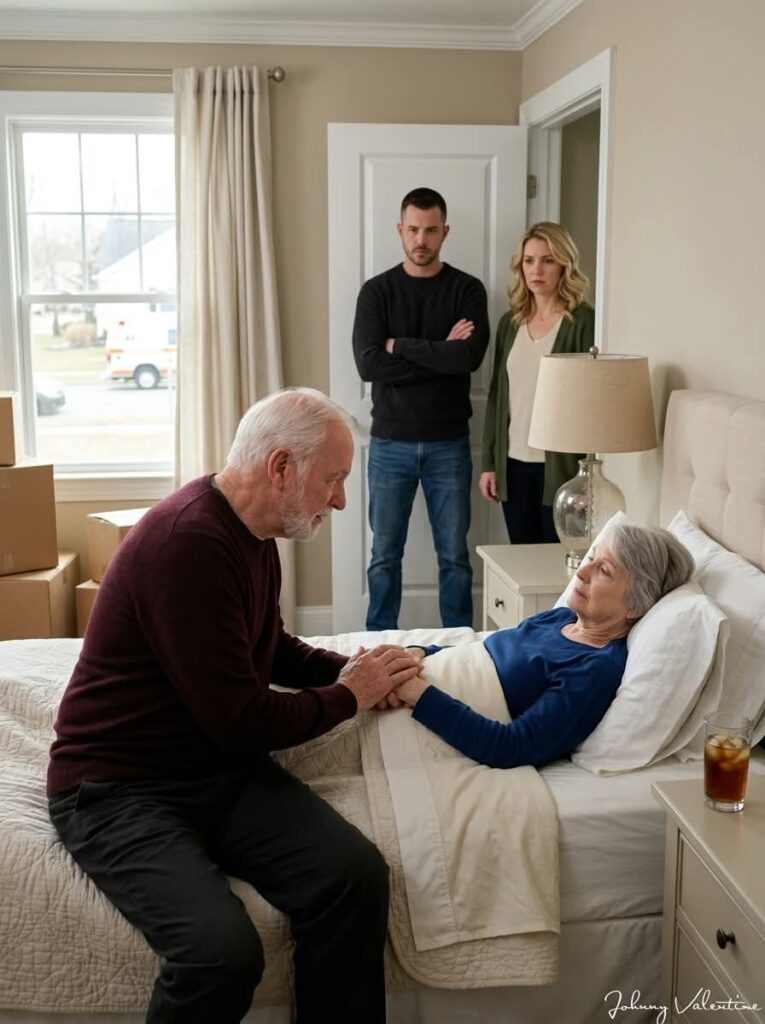
I found Maggie in the upstairs guest room.
The curtains were closed.
The air was stale and heavy.
The room smelled faintly medicinal beneath the perfume of freshly washed sheets.
She lay beneath the blankets.
Only her face was visible.
And the moment I saw her, every explanation Kevin had given me collapsed.
She looked smaller.
Paler.
Her skin had lost its usual warmth.
Her lips were dry.
She looked like someone who had been sick for days.
Like someone whose strength had been quietly drained while everyone downstairs pretended nothing was wrong.
I switched on the lamp.
Her eyelids fluttered.
Then her eyes opened.
She saw me.
“Frank,” she whispered.
The relief on her face frightened me more than anything else.
Because it told me she had been waiting for someone to come.
I sat beside her and took her hand.
It was cold.
“I’m here,” I whispered.
Her fingers closed weakly around mine.
“Help is coming.”
Behind me, Kevin spoke from the doorway.
“She had a reaction to something. We were handling it.”
I slowly turned.
I wasn’t shouting.
I wasn’t angry.
My voice was calm.
Almost unnaturally calm.
It was the same voice I’d used for decades in police work when people were trying to hide the truth behind a wall of excuses.
“Don’t say another word.”
Kevin fell silent.
Minutes later, the paramedics arrived.
They rushed upstairs.
Questions filled the room.
Blood pressure.
Pulse.
Medications.
Symptoms.
How long had she been like this?
Kevin suddenly seemed to have far fewer answers than he had given me downstairs.
Maggie was taken to the hospital.
Kevin and Brittany stayed on the porch.
They didn’t follow us.
They didn’t even try.
And as the ambulance doors closed, I looked back at my son.
That was when fear gave way to something colder.
Investigation.
The investigator in me had finally taken over.
I started putting the pieces together.
The closed curtains.
The missing phone.
The elderly neighbor who had been ignored.
The unexplained collapse.
The paramedics Kevin had turned away.
The sweet tea Brittany brought Maggie every night.
And most disturbing of all—
the expression on Kevin’s face as the ambulance pulled away.
He didn’t look frightened.
He didn’t look heartbroken.
He didn’t even look worried about his mother.
He looked like a man whose plan had just fallen apart.
He looked caught.